
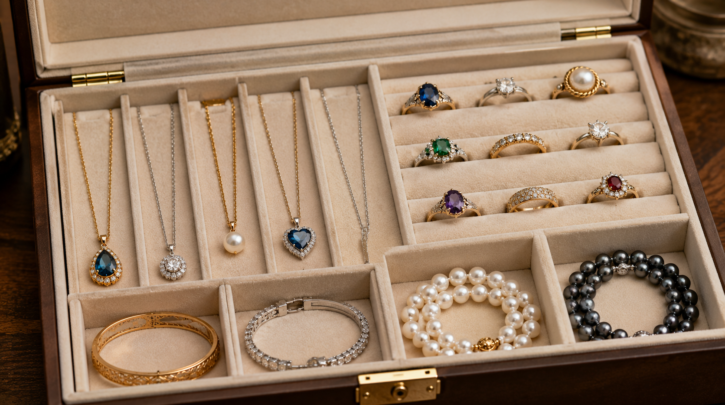

Good storage does more to protect a jewelry collection long-term than any cleaning routine, since it prevents damage before it happens rather than addressing it afterward — a handful of genuinely effective habits cover most of what a mixed jewelry collection needs.
Preventing Silver Tarnish in Storage
Silver jewelry benefits from the same anti-tarnish storage principles as fine silver tableware — anti-tarnish cloth or storage bags, and avoiding contact with rubber bands or other rubber-containing materials, which release sulfur compounds that accelerate tarnishing; see our sterling silver jewelry marks guide for more on caring for silver jewelry specifically.
Separating Hard and Soft Materials
Diamonds and other hard stones can genuinely scratch softer stones, pearls, and even metal surfaces if stored in direct contact — storing pieces in individual pouches or separate compartments prevents this kind of entirely avoidable damage from pieces simply touching each other in storage.
Preventing Chain Tangles
Storing necklaces individually, whether hung separately or laid flat without overlapping, prevents the genuinely frustrating and sometimes damaging tangling that happens when multiple chains are stored loosely together in one compartment.
Controlling Humidity
Excess humidity accelerates silver tarnish and can also contribute to pot metal corrosion in costume jewelry — storing jewelry in a relatively dry environment protects against both issues at once; see our cleaning guide for more on pot metal’s specific vulnerability to humidity-driven deterioration.
Light Exposure Can Fade Some Stones
Certain gemstones, amethyst among them, can genuinely fade with prolonged light exposure — storing jewelry in a dark box or drawer rather than leaving it on constant display under light protects against this kind of slow, easily overlooked fading.
Pearls Need Stable Humidity Too
Being organic, pearls can dry out and develop surface cracks in very low humidity conditions, which is worth keeping in mind alongside the more commonly discussed humidity risks that affect metal components; see our pearl restringing guide for the other major pearl-specific maintenance consideration.
A Simple Long-Term Storage Routine
Clean and dry pieces before storing them, separate hard stones from soft ones, keep necklaces untangled, choose a relatively dry and dark storage location, and use anti-tarnish materials for silver — together, these habits protect a mixed jewelry collection for years without requiring constant active maintenance.
Traveling With Jewelry
For jewelry being transported, whether to a new home or simply to a family gathering, wrapping each piece individually and packing snugly enough to prevent pieces from knocking against each other protects against both scratching and the physical damage that can happen during transit far more effectively than loose packing.
Storing a Mixed Inherited Collection
For a large inherited jewelry box with mixed materials and unknown condition, sorting into separate containers by rough category — fine jewelry, costume jewelry, pearls — before applying category-specific storage principles makes the whole collection considerably easier to protect properly than treating it as one undifferentiated mass; see our fine jewelry identification guide for help with that initial sorting process.
Insurance and Documentation Considerations
Photographing pieces before storing them, especially anything of meaningful value, creates a useful visual record for insurance purposes and makes it easier to notice if a piece’s condition changes over time between inspections; see our appraisal guide for how documentation like this supports a broader insurance or estate planning conversation.
Revisiting Storage as a Collection Grows
What worked for a handful of pieces often stops working as a collection grows, and periodically reassessing whether current storage still separates materials properly, controls humidity adequately, and prevents tangling and scratching is worth doing every so often rather than assuming an early storage setup will scale indefinitely.
Storage as an Investment in Longevity
Time spent setting up thoughtful storage is genuinely one of the highest-value, lowest-effort things a collector can do — unlike cleaning or repair, good storage prevents damage from ever happening in the first place rather than fixing it after the fact.