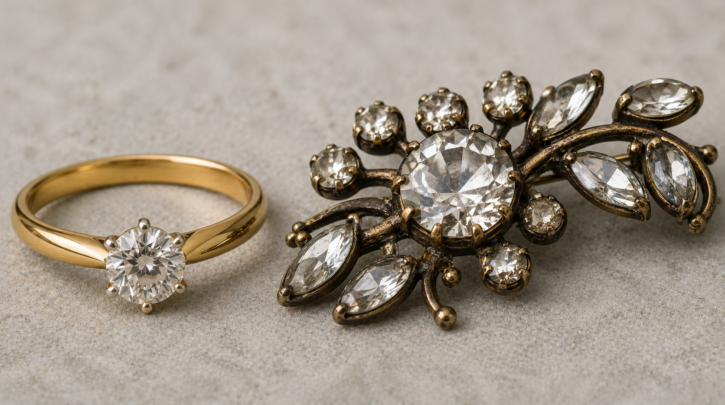

Whether you’re holding solid gold, sterling silver, or well-made costume jewelry, the same core factors determine value — composition, gemstone value, maker, rarity, condition, and completeness — even though the weight each factor carries shifts considerably depending on what you actually have.
Composition Sets the Baseline
Whether a piece is genuine gold, silver, platinum, or costume material is the single biggest factor shaping its value ceiling — fine jewelry carries genuine melt value tied to precious metal markets on top of any collector demand, while costume jewelry depends almost entirely on maker and design; see our real gold vs. costume jewelry guide and costume vs. fine jewelry value guide for how these categories diverge.
Gemstone Value Is Its Own Layer
For fine jewelry set with genuine gemstones, the stones themselves carry separate, sometimes substantial value on top of the metal — a diamond, sapphire, or emerald needs its own evaluation independent of whatever the surrounding gold or platinum is worth; see our gemstone identification guide and diamond basics guide for how to think about stone value specifically.
Maker and Designer Recognition
Widely recognized, historically popular makers — whether fine jewelry houses or top costume jewelry designers like Trifari or Miriam Haskell — generally command stronger demand than unattributed or obscure pieces; see our jewelry makers and designers guides across this site for the names worth learning to recognize.
Rarity of Form and Design
Unusual designs, rare production lines, and pieces from limited runs command real premiums within an otherwise common category — worth researching a specific piece’s documented rarity rather than assuming age alone signals scarcity.
Condition
Bent prongs, missing stones, worn plating, and deteriorated pot metal all reduce value — condition assessment needs to account for both the metal or stones themselves and the overall structural integrity of the piece; see our care guide for how proper handling protects condition over the long term.
Matched Sets Command a Premium
A genuinely matched parure — a coordinated set of pieces such as a necklace, earrings, and bracelet sharing the same design and materials — is generally worth more as a complete set than the same individual pieces would fetch sold separately, since assembling a matching set after the fact takes real effort a buyer often pays a premium to skip.
For Fine Jewelry: Melt Value as a Floor
Genuine gold and other precious metals always carry a calculable minimum value tied to metal weight, functioning as a floor beneath whatever collector or gemstone value sits on top of it; see our melt value guide for how that baseline calculation actually works.
When to Get a Professional Opinion
For a large, uncertain, or potentially valuable collection, a professional appraisal is worth the cost before selling, insuring, or making any irreversible decision; see our appraisal guide for how that process works.
Value Beyond Resale
Knowing a realistic value matters even without any plan to sell — for insurance purposes, for deciding how carefully to store a piece, and simply for understanding what’s actually in a family collection passed down without any record of what it’s worth.
A Grounded Way to Assess a Collection
For anyone assessing an inherited or accumulated collection for the first time, start by confirming composition, identifying maker or design where possible, noting condition and any set gemstones, then check recent completed sales for comparable pieces before assuming either that everything is worthless or that every piece commands a major premium — the honest reality for most collections sits somewhere in between.
Documenting a Collection Over Time
Keeping photos and notes on each piece’s composition, maker, condition, and any set gemstones, alongside whatever price research you’ve done, creates a useful running record whether you eventually sell, insure, or simply want to understand what a family collection actually contains.
That balanced approach protects against both under-selling a genuine rarity and over-insuring a box of common pieces.