
Beyond the handful of giant houses that dominate most costume jewelry conversations, several smaller but genuinely well-regarded signed makers built loyal collector followings of their own, each known for a specific strength worth understanding.
Weiss: Exceptional Rhinestone Quality
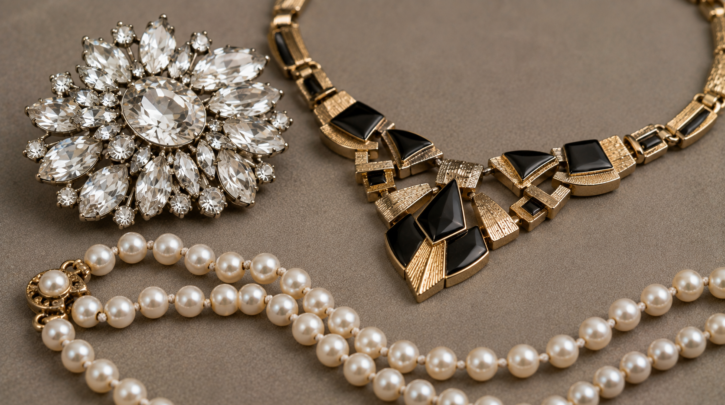
Weiss built its reputation specifically on rhinestone quality, producing stones with clarity and faceting sometimes compared favorably alongside Eisenberg’s well-known oversized stonework; see our most valuable costume jewelry guide for how Eisenberg’s reputation compares directly.
Hobe: A French-Founded American House
Hobe, founded with roots tracing back to French jewelry-making traditions, established itself as a respected American costume jewelry house known for detailed, well-constructed pieces that reflected that European design background.
Schiaparelli: A Fashion Designer’s Jewelry Line
Elsa Schiaparelli, a genuinely significant fashion designer in her own right, also produced signed costume jewelry lines that reflected her bold, fashion-forward design sensibility — a real and legitimate crossover from high fashion into costume jewelry design that adds genuine historical interest to pieces bearing her name.
Marvella: Known for Faux Pearls
Marvella built a specific reputation around high-quality faux pearl jewelry, becoming a go-to name for collectors specifically interested in pearl-focused costume pieces rather than rhinestone-heavy designs.
Regency and Other Smaller Signed Houses
Regency and numerous other smaller signed makers round out the broader landscape of collectible costume jewelry — each with its own specific design focus and collector following, even without the household-name recognition of Trifari or Coro.
Why Smaller Makers Are Worth Learning
Focusing exclusively on the handful of most famous names means missing genuinely well-made, collectible pieces from smaller houses that often sell for considerably less than comparable Trifari or Haskell pieces simply because fewer collectors actively search for them by name.
Researching Smaller Makers
Smaller makers are sometimes less thoroughly documented than the major houses, which means dedicated collector communities and specialty reference guides are particularly valuable for confirming attribution; see our marks and signatures guide for the general research approach worth applying to any less-documented signature.
Building a Collection Around a Specific Strength
Rather than trying to collect every notable maker, many collectors find real satisfaction in focusing on a specific strength — Weiss for rhinestone quality, Marvella for pearls, Schiaparelli for fashion-history crossover — building genuine depth in one area rather than a shallow assortment across every name.
These Names Reward Patient Collecting
None of these smaller houses match the sheer volume of Coro or the instant name recognition of Trifari, which means building a focused collection around any one of them takes real patience — but that same relative scarcity is part of what makes the eventual collection feel genuinely distinctive.
Fashion-World Crossovers Add Historical Interest
Schiaparelli’s jewelry line is a good example of a broader pattern worth watching for — fashion designers and other cultural figures who lent their name and design sensibility to costume jewelry lines, adding a layer of documented cultural history to pieces that goes beyond the jewelry itself.
Cross-Referencing These Names as You Shop
Keeping a mental or written list of these smaller makers’ names and specialties makes them much easier to recognize when browsing a mixed box at an estate sale, where a piece signed by one of these houses might otherwise get overlooked next to more famous names.
A Worthwhile Investment of Time
Learning even a handful of these smaller makers’ names and specialties pays off repeatedly over years of collecting, since recognizing a genuinely good signed piece from a lesser-known house at a fair price is exactly the kind of find that experienced collectors actively look for.
How These Makers Compare on Price
Signed pieces from Weiss, Hobe, and Marvella generally sell for less than comparable Trifari or Haskell pieces of similar quality, simply reflecting smaller collector communities actively bidding on each name — not necessarily lower actual craftsmanship or design quality, which makes these makers a genuinely good value relative to the giants of the hobby.
A Realistic Approach to Learning New Names
Rather than trying to memorize every smaller maker at once, encountering an unfamiliar signature, researching it thoroughly, and retaining what you learn gradually builds a genuinely broad working knowledge over time — far more effective than attempting to study the entire landscape of signed makers in one sitting.
A little focused knowledge about a few names goes a long way further than trying to memorize everything at once.