
Costume jewelry uses non-precious materials — base metals, glass rhinestones, early plastics, enamel — to imitate the look of fine jewelry at a fraction of the price, and identifying genuine, well-made vintage pieces comes down to construction quality, signatures, and materials rather than any metal or stone purity mark.
The Golden Age of American Costume Jewelry
Roughly the 1930s through the 1960s is widely considered the golden age of American costume jewelry, when major houses like Trifari, Coro, Weiss, and Miriam Haskell produced genuinely design-forward, well-crafted pieces that collectors prize today independent of their material value — this era’s output forms the core of serious costume jewelry collecting.
Construction Quality Is the Real Tell
Soldered joints and prong-set stones generally indicate more careful, higher-quality construction than glued joints and glued-in stones, which were more common in cheaper mass-market pieces — examining how a piece is actually put together tells you more about its quality tier than the material alone ever could.
Rhinestone Quality
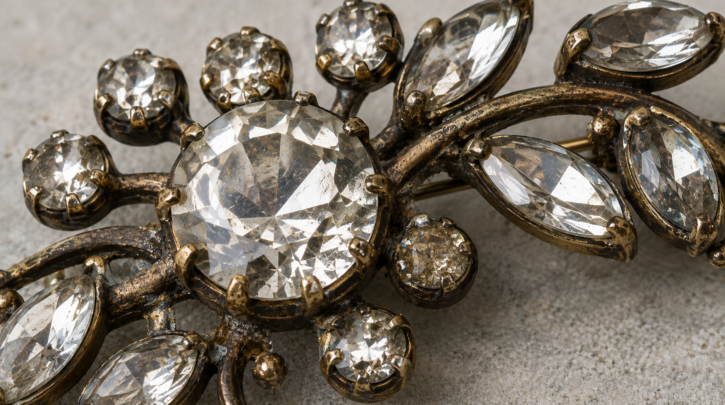
Genuine vintage rhinestones are cut glass with a foil backing that enhances sparkle and reflects light distinctively, and the quality of both the faceting and the foil backing varies noticeably between a cheap mass-produced piece and a carefully made one from a top-tier house — worth examining closely under good light rather than judging sparkle from a quick glance.
Materials Worth Recognizing
Beyond rhinestones, vintage costume jewelry commonly used Bakelite and other early plastics, enamel work, faux pearls, and a zinc alloy commonly called pot metal for structural components — each material has its own care considerations and collector following distinct from the piece’s overall design or maker; see our cleaning guide for material-specific care, including pot metal’s particular vulnerability to a deterioration issue collectors call pot metal disease.
Checking for a Signature
A maker’s signature or mark, when present, dramatically narrows down research and generally increases both confidence in identification and collector value; see our marks and signatures guide for where to look and how to research a mark you don’t immediately recognize.
Dating a Piece by Its Findings
Clasp styles, pin backs, and other small hardware components — collectively called findings — changed over the decades in fairly documented ways, which means the specific type of clasp or pin mechanism on a piece can offer a genuine supporting clue for roughly dating it even without a maker’s mark to work from.
Confirm What You’re Actually Holding First
Before researching a specific piece’s maker or era, our free 5-Second Real Gold vs. Costume Jewelry Checklist confirms whether you’re looking at costume jewelry or genuine precious metal in the first place.
Most Costume Jewelry Is Genuinely Modest in Value
It’s worth being honest upfront: most vintage costume jewelry, even attractive and well-made pieces, carries modest collector value — only specific makers, rare lines, and exceptional pieces command the kind of serious money that shows up in headlines; see our most valuable costume jewelry guide for what actually sets those exceptional pieces apart.
Where Vintage Costume Jewelry Turns Up
Estate sales, inherited jewelry boxes, and antique malls remain the most common sources, and because costume jewelry was genuinely worn and accumulated in massive quantities across the mid-20th century, unidentified pieces show up in general circulation constantly; see our buying guide for what to expect across different sourcing options.
A Reasonable Starting Approach
For a box of mixed costume jewelry, checking each piece for a signature first, then assessing construction quality on the unsigned pieces, gives the most efficient path to identifying which items are worth deeper research and which are simply attractive but ordinary vintage pieces.
A Genuinely Good Entry Point for New Collectors
Because most vintage costume jewelry is affordable, it’s a genuinely accessible way to start learning identification and research skills without the financial stakes attached to fine jewelry — skills that transfer directly if you later move into collecting fine jewelry as well.
Handling Pieces Builds Real Confidence
Nothing substitutes for physically handling a range of genuine vintage pieces — at shows, through a collector club, or simply comparing several pieces from your own growing collection side by side — to build the tactile sense of weight, construction, and material quality that written descriptions can only approximate.