
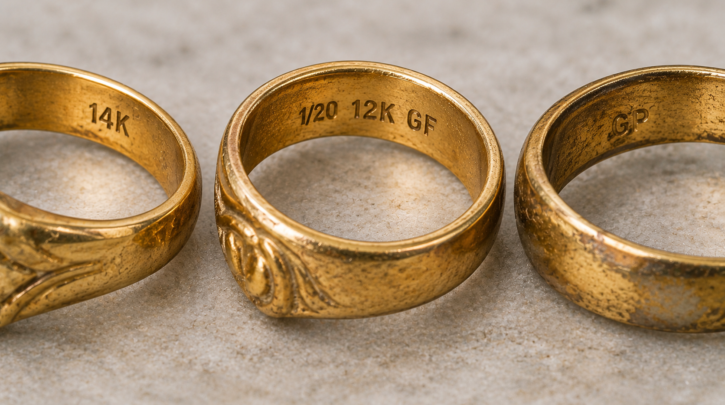

Reading the marks stamped into a piece of gold jewelry is the fastest, most reliable way to confirm genuine gold content, understand its purity, and distinguish solid gold from gold-filled or gold-plated pieces that only look similar at a glance.
The Karat System
American gold jewelry is marked with a karat number out of 24 — 24K is pure gold, 22K is about 91.7% pure, 18K is 75% pure, 14K is 58.3% pure, and 10K is 41.7% pure. In the United States, 10 karat is the legal minimum purity that can be marked and sold as gold at all, which is worth knowing since anything below that threshold isn’t legally gold jewelry regardless of how it’s described.
International Numeric Marks
Many countries use a numeric purity mark instead of the karat system — 999 for pure gold, 916 for 22 karat, 750 for 18 karat, 585 for 14 karat, and 417 for 10 karat, expressing purity as parts per thousand rather than parts out of 24, conceptually similar to how sterling silver uses “925”; see our sterling silver jewelry marks guide for that direct parallel.
Higher Karat vs. Lower Karat Tradeoffs
Higher karat gold contains more actual gold and is worth more per gram, but it’s also softer and more prone to scratching and wear, while lower karat gold trades some purity for durability thanks to the additional alloy metal mixed in — neither is objectively “better,” just suited to different priorities.
Gold-Filled: A Genuinely Different Category
Gold-filled jewelry uses a comparatively thick layer of real gold mechanically bonded to a base metal core, typically marked with a fraction like “1/20 12K GF,” meaning the gold layer makes up one-twentieth of the total metal weight in 12 karat gold. This is meaningfully different from thin gold plating — gold-filled pieces contain a real, if modest, amount of actual gold and can hold up to years of wear far better than plated pieces.
Gold-Plated: Minimal Gold Content
Gold-plated jewelry, marked “GP” or similar, uses a very thin layer of gold electroplated onto a base metal surface, containing far less actual gold than gold-filled pieces and carrying essentially no meaningful melt value — the gold-colored surface can also wear through to the base metal over time with regular use, similar to how silver-plated tableware can wear through; see our fakes and alterations guide for why this distinction matters so much when buying.
Vermeil: A Specific Named Combination
Vermeil refers specifically to sterling silver with a gold plating layer on top, a distinct and specifically named category rather than a generic term for any gold-over-silver combination — worth recognizing as its own thing when you see the term used in a listing or description.
Maker’s Marks Alongside Karat Marks
Fine jewelry often carries a separate maker’s or designer’s mark alongside the karat stamp, and identifying that maker adds real context and often real value beyond the metal content alone; see our jewelry makers and designers guides across this site for how maker identification works in practice.
A Practical Reading Order
- Check for a karat number or numeric purity mark first to confirm gold content
- Look for GF or GP markings that indicate gold-filled or gold-plated rather than solid gold
- Note any maker’s mark alongside the metal mark
- Compare the overall mark style against known genuine examples if anything looks unusual
Marks Can Wear Away Over Decades
A ring worn daily for fifty years can have its interior karat stamp worn nearly illegible, which doesn’t mean the piece isn’t genuine gold — weight, color, and professional testing become more important supporting checks whenever a mark is present but difficult to read with full confidence.
Documenting Marks as You Sort a Collection
Photographing each distinct mark clearly, especially when working through a large inherited jewelry box with mixed pieces from different eras and makers, creates a useful reference for cross-checking later and for sharing with a jeweler or appraiser if questions come up.
Regional Variation in Karat Preferences
Different countries historically favored different typical karat levels — 18K and higher are more common in much of Europe and the Middle East, while 10K and 14K have been more typical in everyday American jewelry — worth keeping in mind when a piece’s origin is uncertain, since an unusually high karat mark can sometimes hint at where a piece was originally made.