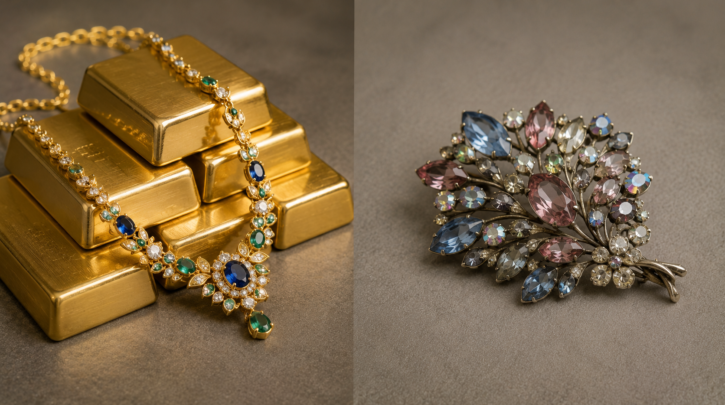

The fundamental difference between costume and fine jewelry value isn’t just about materials — it’s about what actually sets the price floor, and understanding that difference changes how you should think about value in each category.
Fine Jewelry Has a Value Floor
Genuine gold, silver, and platinum jewelry always carries a calculable minimum value tied to metal weight and current commodity prices, with gemstones adding further documented value on top of that baseline; see our gold melt value guide for how that baseline calculation works.
Costume Jewelry Has No Such Floor
Because costume jewelry contains no meaningful precious metal or gemstone content, its entire value rests directly on collector demand for that specific maker, design, and condition — there’s no underlying commodity value functioning as a safety net beneath a piece that falls out of collector favor.
This Makes Costume Jewelry Values More Trend-Sensitive
Because costume jewelry pricing depends entirely on collector demand rather than a metal-backed floor, prices for a specific maker or design era can shift more with changing collector tastes than fine jewelry prices typically do — a design house currently in fashion among collectors can see real price appreciation, while a less fashionable one stays flat, in a way that doesn’t affect fine jewelry’s underlying metal value the same way.
Both Categories Deserve Genuine Collector Respect
Costume jewelry from top makers, in excellent condition, with confirmed rarity, routinely outsells modest fine jewelry pieces despite having zero melt value — it’s worth pushing back on any assumption that costume jewelry is automatically “worth less” than fine jewelry; see our most valuable costume jewelry guide for real examples of this pattern.
Appraisal Approach Differs Between the Two
A fine jewelry appraisal needs to account for both metal and gemstone value alongside any collector premium, while a costume jewelry appraisal is almost entirely about design, maker, and condition research, since there’s no metal or stone value baseline to factor in; see our appraisal guide for how this distinction shapes the appraisal process itself.
A Practical Takeaway
Before assuming a piece’s value based on category alone, confirm composition first, then research maker and design specifically — a modest fine jewelry piece and an exceptional costume piece can easily land on opposite sides of expectations set by assuming metal content alone determines worth.
Neither Category Is Inherently the ‘Better’ Investment
Fine jewelry offers the security of a metal-backed floor but generally slower collector-driven appreciation on top of that baseline, while costume jewelry offers no floor at all but genuine upside potential for pieces from the right maker in the right condition — neither approach is objectively superior, and many serious collectors deliberately hold both.
Building Expertise in Either Category Takes Time
Whether focusing on fine jewelry’s metal and gemstone evaluation or costume jewelry’s maker and design research, real expertise develops through handling genuine pieces repeatedly and comparing them against documented examples — there’s no shortcut that replaces this kind of hands-on, accumulated experience in either category.
How This Plays Out When Selling
Selling fine jewelry usually starts with a floor price based on melt and gemstone value, with collector demand potentially adding more on top — selling costume jewelry starts from zero and depends entirely on finding a buyer who specifically wants that maker and design, which means research and accurate identification matter even more before setting a price.
Insurance Considerations Differ Too
Insuring fine jewelry typically relies on documented metal weight and gemstone grading alongside any collector premium, while insuring valuable costume jewelry depends much more heavily on a documented appraisal establishing maker, rarity, and condition, since there’s no commodity-based starting point an insurer can simply calculate independently.
Getting this distinction right before purchasing insurance coverage avoids both under-protecting a genuinely valuable costume piece and overpaying to insure a common one.