
Trifari is one of the most recognized names in American costume jewelry, founded by Gustavo Trifari and later joined by Leo Krussman and Carl Fishel, and its reputation for genuine design sophistication set it apart from most of its mass-market competitors.
The Crown Mark
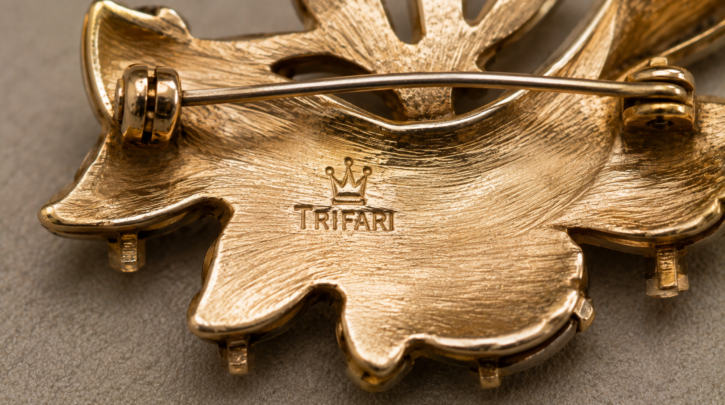
Trifari’s signature mark — the word “Trifari” beneath a small crown symbol — is among the most recognized trademarks in the entire costume jewelry hobby, and like many long-running makers’ marks, its exact styling evolved somewhat across the company’s operating history, which collectors sometimes use as a rough dating clue alongside other evidence.
Alfred Philippe: A Fine Jewelry Designer in Costume Work
Trifari’s reputation for design quality owes an enormous amount to Alfred Philippe, who joined the company around 1930 after previously working for fine jewelry houses including Cartier — bringing genuine fine-jewelry design sensibility and technique to costume jewelry in a way few competitors could match, and largely explaining why Trifari pieces are held in such high collector regard today.
The Jelly Belly Line
Among Philippe’s most famous designs are the “Jelly Belly” figural brooches from the 1930s and 1940s, using a clear lucite “belly” as the body of an animal or figure — among the single most sought-after rarities in the entire costume jewelry hobby; see our most valuable costume jewelry guide for more on why these specific pieces command such strong collector interest.
Trifanium: A Distinctive Base Metal
Trifari developed and used an alloy it marketed as “Trifanium,” promoted as more durable and tarnish-resistant than the typical pot metal common across the rest of the industry — a genuine material distinction that set Trifari construction apart from many competitors using less durable base metals.
A Notable Historical Association
Trifari created jewelry worn at Mamie Eisenhower’s 1953 inaugural events, a genuinely notable historical association that reflects the level of design credibility the company had achieved by the mid-20th century — a detail worth knowing as context for why Trifari is held in such esteem within the hobby.
Signature Evolution and Dating
Like most long-running makers, Trifari’s mark changed in small ways over the decades, and comparing an unfamiliar mark’s exact styling against documented examples from different eras can help narrow down roughly when a specific piece was made; see our marks and signatures guide for the general principles behind this kind of dating.
Finding Trifari Pieces
Given the company’s long operating history and genuinely large production volume, Trifari pieces turn up regularly on the secondary market, making the brand a reasonable starting point for a new costume jewelry collector despite the real premium its rarest specific designs command.
Search current Trifari listings Search Trifari jewelry on eBay
Trifari’s Place in Costume Jewelry History
Few names carry as much combined recognition and genuine design credibility as Trifari, which makes the brand a natural first stop for any new collector trying to understand what separates truly well-designed costume jewelry from merely decorative mass production.
Caring for Trifari’s Rhinestone Work
Trifari’s rhinestone settings deserve the same gentle care as any fine vintage rhinestone piece — avoiding soaking, which can loosen glued-in stones and damage foil backing that gives genuine sparkle; see our cleaning guide for the specific techniques worth using on rhinestone-heavy pieces like Trifari’s.
Beyond Jewelry: A Broader Design Legacy
Trifari’s influence extended beyond individual pieces to helping establish costume jewelry generally as a legitimate design category worthy of serious collector attention, rather than simply an inexpensive substitute for fine jewelry — a genuine shift in perception the company’s design quality helped bring about.
Assessing an Inherited Trifari Piece
For an inherited or found Trifari piece, checking the mark style against documented eras, inspecting rhinestone condition closely, and confirming whether it resembles any documented rare line like the Jelly Bellies gives a reasonable first sense of what you’re actually holding before assuming either an ordinary or an exceptional value; see our jewelry value guide for the broader framework this assessment fits into.
Trifari’s Enduring Collector Appeal
Decades after its peak production era, Trifari remains one of the most actively collected costume jewelry names, with a genuinely stable and knowledgeable collector community that keeps reference information and comparable sale data readily available — a genuine advantage for research compared to less documented makers.
That combination of design quality and research accessibility makes Trifari a genuinely rewarding maker to specialize in.
Few other names offer this much depth for a new collector to grow into over time.