
Cut, color, clarity, and carat weight — the “4 Cs” — form the standard universal framework for evaluating any diamond, and understanding what each one actually measures clears up a surprising amount of common confusion.
Cut: Not the Same as Shape
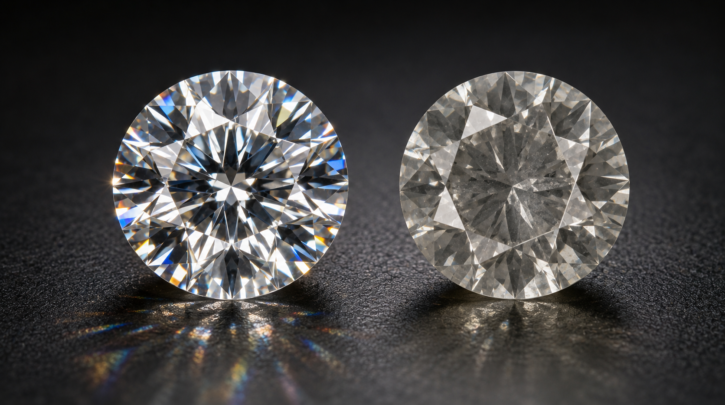
Cut refers to how well-proportioned and faceted a diamond is, which is genuinely different from its shape — “round brilliant” describes a shape, while cut grade describes the quality of proportioning within that shape. A well-cut diamond returns significantly more light and sparkle than a poorly cut one of the exact same shape, size, and clarity.
Color: Graded D Through Z
Standard white diamonds are graded on a letter scale from D, completely colorless and most valuable, down through Z, noticeably tinted yellow or brown — this scale, developed and maintained by the Gemological Institute of America, is the widely recognized industry standard for describing a diamond’s color precisely.
Clarity: Internal and External Characteristics
Clarity grades run from Flawless and Internally Flawless down through Very Very Slightly Included, Very Slightly Included, Slightly Included, and Included grades, describing the internal and external characteristics — inclusions and blemishes — visible under magnification. Most diamonds used in jewelry fall well below flawless, and many clarity grades are entirely invisible to the naked eye despite being detectable under a jeweler’s loupe.
Carat: A Unit of Weight, Not Size
A carat is a unit of weight, equal to 200 milligrams, not a direct measurement of visual size — two diamonds of the same carat weight can look different in size depending on how they’re cut, which is part of why cut quality matters so much for how large a diamond actually appears when worn.
GIA Certification
The Gemological Institute of America is widely regarded as the most respected independent diamond grading lab, and a GIA certificate or report for a specific stone provides trusted, third-party documentation of its actual 4 Cs grading — genuinely valuable documentation to look for or request when buying any diamond of meaningful value.
Diamond Testing Tools and Their Limits
Handheld diamond testers, which measure thermal conductivity, are commonly used professional and consumer tools for a first-pass check — worth knowing that moissanite, a diamond simulant, has similar thermal properties and can fool a basic thermal tester, which is part of why more thorough professional testing matters for anything valuable enough to justify the cost.
How Antique Diamonds Fit Into This Framework
Diamonds cut before the modern era used genuinely different cutting styles optimized for different visual effects than today’s standard proportions; see our antique cut diamonds guide for how older cuts like the Old Mine and Old European cut relate to the modern cut-grading framework covered here.
Putting the 4 Cs Together
No single C tells the whole story on its own — a large carat weight with poor cut quality can look underwhelming, while a smaller, exceptionally well-cut diamond can appear more brilliant and impressive than its size alone would suggest, which is why professional grading considers all four factors together rather than any one in isolation.
Fluorescence: A Fifth Factor Worth Knowing
Beyond the core 4 Cs, some diamonds exhibit fluorescence under ultraviolet light, which GIA reports also document — strong fluorescence can affect appearance and, in some cases, price, though its effect varies enough between individual stones that it’s worth treating as a secondary consideration rather than a primary grading factor.
Buying With Confidence
Requesting a GIA report for any diamond purchase of meaningful value, and understanding what each of the 4 Cs on that report actually means, turns an intimidating purchase into a genuinely informed decision rather than one based on trusting a seller’s description alone.
That informed footing matters just as much for a modest purchase as it does for a significant one.