
A stamped karat and a piece on a scale will tell you the melt-value floor of any gold piece in about a minute — that number isn’t going anywhere, and it’s the least you’ll get for it. What that number can’t tell you is whether the piece is worth several times more than that floor, which depends entirely on two things a scale can’t measure: a recognized maker’s mark and whether any stones are natural and untreated. Getting both questions answered before you decide who to sell to matters more than any other step in this process, because the right buyer for a plain gold band is the wrong buyer for a signed piece with real stones, and vice versa.
Test and Identify Before You Choose a Buyer
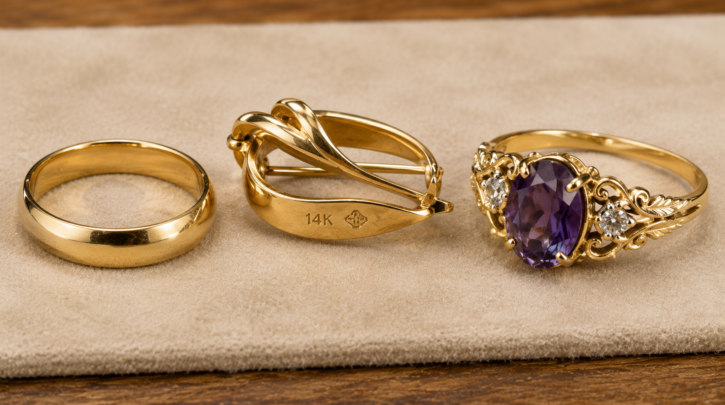
Start with the stamp — 10K, 14K, or 18K confirms solid gold, and combined with weight and current spot price, it sets a hard melt-value floor; see our gold melt value explained guide for the actual math. Then look for what the stamp check alone won’t show: a maker’s signature or hallmark, and whether any set stones look like they could be natural rather than synthetic or glass.
Our fine jewelry identification guide and costume jewelry identification guide cover the frameworks for both. A recognized maker’s mark or a documented natural stone can push a piece to many multiples of its melt value — which is exactly the value a refiner won’t pay for, and exactly the value an estate jewelry dealer or auction house will.
The Melt Floor: Selling to a Refiner
A gold refiner pays strictly for melt value — karat purity and weight against current spot price, nothing more. That makes a refiner the right call for plain gold bands, damaged or incomplete pieces, and anything unsigned with no stones worth mentioning, where the melt floor is genuinely the ceiling too. It’s fast and the price is predictable, but a refiner has no reason to pay a premium for a maker’s name or a gemstone’s origin, so sending a signed or stone-set piece straight to a refiner without checking first is the single most common way sellers leave real money on the table. See our melt vs. sell guide before deciding a piece belongs here.
Above the Floor: Selling to an Estate Jewelry Dealer
Once identification turns up a recognizable maker’s mark or stones worth documenting, an estate jewelry dealer who can actually recognize and price that premium becomes the better outlet than a refiner. A dealer specializing in period pieces knows what a specific maker’s signature is currently bringing among collectors and can price a natural stone against current gemstone demand rather than melt value alone — value a refiner has no mechanism to account for.
Atique specializes specifically in vintage and antique jewelry, making it a natural fit for signed pieces or pieces with documented period character and genuine stones.
Sell your vintage jewelry through Atique: Learn more about selling at Atique
When It’s Rare Enough for an Auction House
For anything that seems like it could be a genuinely rare design, a significant gemstone, or a piece from a well-documented major maker, a formal appraisal is worth getting before you decide between a dealer and an auction house — see our appraisal guide for how that process works and when it earns its cost. An auction house makes sense once a piece is genuinely competitive-bidding material: documented rarity, a notable signed maker, or a certified gemstone can draw multiple serious collectors bidding against each other, sometimes producing a result well above what a single dealer would offer outright.
Clean Gently Before Photographing
A gentle clean before listing genuinely helps a piece show well in photos, but resist the urge to attempt any deeper restoration or aggressive polishing right before a sale — a well-meaning cleaning can remove patina or original finish that collectors specifically value. See our cleaning guide for the material-specific gentle approach worth using on any piece headed for sale.
Photography That Actually Sells
Clear, well-lit photos of any maker’s mark or signature, the stones themselves, and construction detail — prong-set versus glued stones, for instance — give serious buyers the specific details they’re actually looking for. Collectors buying online rely heavily on these detail shots to confirm composition and maker before purchasing, so a close-up of the stamp is not optional if you want serious offers.
Honest Condition Disclosure
Disclosing missing stones, bent prongs, replaced parts, or any prior repairs clearly and specifically, rather than using vague language, protects your reputation as a seller and avoids disputes after a sale. Serious buyers specifically appreciate sellers who describe condition precisely.
Pricing Costume Jewelry
Costume jewelry pricing depends entirely on maker, design, and condition rather than any metal value baseline, which makes accurate identification even more important before setting a price. See our value guide for how this pricing approach differs from fine jewelry, where a melt floor at least gives you a starting number.
Writing a Listing That Builds Trust
A detailed, specific listing — exact maker if known, composition, stone details, precise measurements, and an honest condition description — consistently outperforms a vague one, since serious buyers actively search for specific makers and skip past listings that don’t clearly identify what’s actually being sold.
Selling to the General Collector Market
For pieces better suited to a broader buyer pool than a specialty dealer or auction house — solid but less distinctive signed pieces, or costume jewelry without major-maker status — general marketplaces reach the largest possible audience of interested buyers.
Check current listings and completed sales for your piece: Search vintage jewelry on eBay
Shipping Jewelry Safely and Discreetly
Jewelry is small but often genuinely valuable, which means careful packaging to prevent scratching, purchasing shipping insurance for anything of meaningful value, and using discreet, unmarked outer packaging that doesn’t announce valuable contents — all of which matter for protecting a shipment both from damage and from theft.
Being Patient With Rare Pieces
A genuinely rare design or a piece from a significant maker sometimes takes longer to find the right buyer than a common piece would, simply because the pool of interested collectors is smaller. Resist the urge to drop the price prematurely on something truly scarce just because it hasn’t sold in the first week or two — this is often exactly the piece an auction house or specialty dealer will do better with than a fast marketplace sale.
Selling a Whole Collection at Once
For someone liquidating an entire inherited or accumulated collection rather than a few individual pieces, an estate sale company or a dealer offering to buy the full lot outright can be more practical than listing dozens of individual items one at a time, even though the per-piece return is typically lower than patient individual sales would bring.
Either approach can work well — the right choice depends on how much time and effort you want to invest in the sale itself.